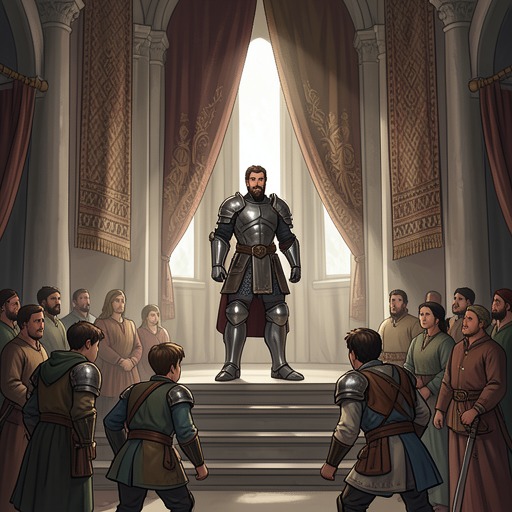
opening of the pilgrimage season
Spring Awakening
As [April](entity:time-recall-time-april-2c2e37855810) rains revive the earth and [May](entity:time-recall-time-may-1281a8b8ee63) approaches, nature stirs birds and human hearts alike. The season’s renewal summons travelers toward distant shrines, especially toward [Canterbury](entity:location-recall-location-canterbury-d9d154d6633e) and the tomb of its blissful martyr.
The opening establishes pilgrimage as both religious devotion and social movement, joining spiritual aspiration to seasonal desire and setting the journey’s festive, unstable energy.
one evening in spring
The Pilgrims Gather
The narrator reaches [The Tabard](entity:location-recall-location-the-tabard-2f392a02f43d) in [Southwark](entity:location-recall-location-southwark-1b8d7f8e417b) and finds a company of twenty-nine pilgrims brought together by chance. After speaking with each traveler, he becomes part of their fellowship and prepares to ride with them.
Their gathering creates the book’s social miniature: knights, clergy, merchants, professionals, laborers, and rogues travel side by side, making the pilgrimage a stage for [Estates satire](entity:concept-recall-concept-estates-satire-6b9ea9e3fee1).
before departure from The Tabard
The Pilgrim Portraits
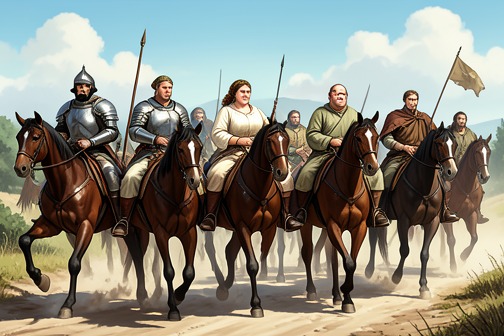
The narrator presents the company, beginning with [The Knight](entity:character-recall-character-the-knight-7d7d568c8fd2) and [The Squire](entity:character-recall-character-the-squire-ad8deb644c53), then describing [The Yeoman](entity:character-recall-character-the-yeoman-a31337b8d436), [Madam Eglantine](entity:character-recall-character-madam-eglantine-68139ea8cf22), [The Monk](entity:character-recall-character-the-monk-6d5091022914), [Hubert](entity:character-recall-character-hubert-c2de324a04ce), [The Merchant](entity:character-recall-character-the-merchant-b108f7545dad), [The Oxford Student](entity:character-recall-character-the-oxford-student-0a27d255fe5f), [The Sergeant of the Law](entity:character-recall-character-the-sergeant-of-the-78d2f6e771b6), [The Franklin](entity:character-recall-character-the-franklin-696b405714d2), [The Wife of Bath](entity:character-recall-character-the-wife-of-bath-468f3f925d04), [The Parson](entity:character-recall-character-the-parson-5b17df8a9564), [The Plowman](entity:character-recall-character-the-plowman-f9e084429f14), [The Miller](entity:character-recall-character-the-miller-f37b57225ae1), [The Manciple](entity:character-recall-character-the-manciple-8d1509bb8c20), [The Reeve](entity:character-recall-character-the-reeve-72e2b90a7f88), [The Summoner](entity:character-recall-character-the-summoner-31d8b7cf0035), and [The Pardoner](entity:character-recall-character-the-pardoner-4c938837b23d).
The portraits contrast genuine virtue with vanity, corruption, appetite, professional expertise, and self-deception. The Parson and The Plowman embody lived charity, while several churchmen expose clerical corruption and the gap between office and conduct.
the pilgrims’ first night
The Storytelling Compact
After supper, [Harry Bailly](entity:character-recall-character-harry-bailly-c19f8e2f6655) proposes that each pilgrim tell two tales on the way to [Canterbury](entity:location-recall-location-canterbury-d9d154d6633e) and two on the return. The best storyteller will receive a supper paid for by the company, while Harry Bailly will guide and judge them.
The company accepts the rules, transforming travel into a structured contest. Storytelling becomes the means by which the pilgrims compete, reveal themselves, and test competing ideas of authority and virtue.
the next morning
The Knight Draws First
At Saint Thomas’s watering place, [Harry Bailly](entity:character-recall-character-harry-bailly-c19f8e2f6655) reminds the pilgrims of their agreement and orders them to draw lots. The shortest lot falls to [The Knight](entity:character-recall-character-the-knight-7d7d568c8fd2), who accepts the duty cheerfully and begins his tale as the company rides toward [Canterbury](entity:location-recall-location-canterbury-d9d154d6633e).
The scene establishes chance as an organizing force, while The Knight’s precedence gives the first narrative a formal, courtly tone.
before the main action of The Knight’s Tale
Theseus Conquers Femeny
[Theseus](entity:character-recall-character-theseus-d07fe0f16827), lord of [Athens](entity:location-recall-location-athens-829baca0905a), conquers [Femeny](entity:location-recall-location-femeny-0d875c01371d), defeats the Amazons, and marries [Hippolyta](entity:character-recall-character-hippolyta-e79a2429b7a8). He brings Hippolyta and her younger sister [Emily](entity:character-recall-character-emily-79a1b5f3c22d) home in a magnificent triumph.
His conquest establishes Theseus as a powerful ruler governed by chivalry and public order, while Emily enters the story as the woman whose future will draw two captive Theban nobles into conflict.
during Theseus’s return from Femeny
The Women Appeal to Theseus
Near [Athens](entity:location-recall-location-athens-829baca0905a), grieving women stop [Theseus](entity:character-recall-character-theseus-d07fe0f16827) and beg for mercy. Their husbands were killed at [Thebes](entity:location-recall-location-thebes-287d4a7870ec), and [Creon](entity:character-recall-character-creon-1f348ca96dc8) has denied them burial, leaving the corpses exposed to dogs.
The women’s appeal interrupts triumph with suffering. Their grief activates Theseus’s chivalric duty and turns private mourning into a cause for royal vengeance.
immediately after the women’s appeal
Theseus Venges Creon
[Theseus](entity:character-recall-character-theseus-d07fe0f16827) turns his army toward [Thebes](entity:location-recall-location-thebes-287d4a7870ec) rather than entering [Athens](entity:location-recall-location-athens-829baca0905a). He defeats and kills [Creon](entity:character-recall-character-creon-1f348ca96dc8), destroys the city, and restores the slain men’s bones to their widows for honorable rites.
Theseus’s vengeance establishes justice through force, but it also exposes the destructive cycle of aristocratic violence that will later reappear in the rivalry between [Palamon](entity:character-recall-character-palamon-5353b9d6d0aa) and [Arcite](entity:character-recall-character-arcite-aa9ab95f08d9).
after the battle at Thebes
The Captive Thebans Found
Among the dead, soldiers discover two badly wounded young knights, [Palamon](entity:character-recall-character-palamon-5353b9d6d0aa) and [Arcite](entity:character-recall-character-arcite-aa9ab95f08d9), who are cousins and members of the Theban royal family. [Theseus](entity:character-recall-character-theseus-d07fe0f16827) sends them to [Athens](entity:location-recall-location-athens-829baca0905a) and imprisons them without ransom.
Their imprisonment converts defeated political enemies into rival lovers. Their shared captivity initially binds them together, but their later desire for [Emily](entity:character-recall-character-emily-79a1b5f3c22d) will turn kinship into lethal competition.
seven years into the imprisonment
Emily Appears in May
One [May](entity:time-recall-time-may-1281a8b8ee63) morning, [Emily](entity:character-recall-character-emily-79a1b5f3c22d) rises before dawn, dresses brightly, gathers flowers in the garden, and sings. Her beauty is visible from the tower where the two prisoners are confined.
The scene joins May’s regenerative force to courtly idealization. Emily does not yet choose either man, but her appearance becomes the visual event that reorganizes both prisoners’ lives.
the same May morning
The Cousins Fall in Love
[Palamon](entity:character-recall-character-palamon-5353b9d6d0aa) sees [Emily](entity:character-recall-character-emily-79a1b5f3c22d) first and believes her to be [Venus](entity:character-recall-character-venus-c3ad2d1b04e1); [Arcite](entity:character-recall-character-arcite-aa9ab95f08d9) then sees her and is struck by the same desire. They argue over precedence, each claiming to love her more deeply and accusing the other of betrayal.
Their bond collapses under the logic of courtly love. Each invokes the principle that love recognizes no human law, turning shared captivity into a contest for possession.
shortly after the lovers’ quarrel
Arcite Receives Exile
[Perotheus](entity:character-recall-character-perotheus-f66c3dc3643b) persuades [Theseus](entity:character-recall-character-theseus-d07fe0f16827) to release [Arcite](entity:character-recall-character-arcite-aa9ab95f08d9) without ransom, but Arcite must leave all lands ruled by Theseus or lose his head. Arcite returns toward [Thebes](entity:location-recall-location-thebes-287d4a7870ec) in despair, envying [Palamon](entity:character-recall-character-palamon-5353b9d6d0aa)’s continued sight of [Emily](entity:character-recall-character-emily-79a1b5f3c22d).
Freedom becomes another form of imprisonment: Arcite can move through the world but cannot approach the woman he loves. The contrast deepens the tale’s meditation on Fortune’s reversals.
immediately after Arcite’s release
Palamon Mourns Arcite’s Freedom
[Palamon](entity:character-recall-character-palamon-5353b9d6d0aa) remains chained in the tower and laments that [Arcite](entity:character-recall-character-arcite-aa9ab95f08d9) can now return to [Thebes](entity:location-recall-location-thebes-287d4a7870ec), gather allies, and perhaps win [Emily](entity:character-recall-character-emily-79a1b5f3c22d). Jealousy intensifies his prison suffering, while he questions why human beings endure punishment despite innocence.
His complaint broadens the personal rivalry into a philosophical crisis involving [Saturn](entity:character-recall-character-saturn-5fbf2e1adb80), Juno, [Venus](entity:character-recall-character-venus-c3ad2d1b04e1), divine providence, and the apparent injustice of human fate.
about a year after Arcite’s exile
Arcite Dreams of Mercury
[Arcite](entity:character-recall-character-arcite-aa9ab95f08d9), physically wasted by lovesickness, dreams that [Mercury](entity:character-recall-character-mercury-dc08adc34fea) commands him to go to [Athens](entity:location-recall-location-athens-829baca0905a), where his suffering will end. He decides that seeing [Emily](entity:character-recall-character-emily-79a1b5f3c22d) is worth the danger of death.
The dream turns forbidden return into an apparently sanctioned mission. Arcite’s desire overcomes political identity and leads him toward disguise, service, and renewed proximity to Emily.
after the Mercury dream
Arcite Becomes Philostrate
[Arcite](entity:character-recall-character-arcite-aa9ab95f08d9) disguises himself as a poor laborer and enters [Athens](entity:location-recall-location-athens-829baca0905a) under the name Philostrate. He serves in [Emily](entity:character-recall-character-emily-79a1b5f3c22d)’s household, gains a reputation for virtue, and is eventually elevated by [Theseus](entity:character-recall-character-theseus-d07fe0f16827) to a respected position at court.
The disguise allows Arcite to live close to Emily while concealing his identity from Theseus. His social rise also complicates the tale’s idea of nobility, suggesting that gentilesse may be enacted rather than inherited.
the seventh year of imprisonment
Palamon Escapes
With a friend’s help, [Palamon](entity:character-recall-character-palamon-5353b9d6d0aa) drugs his jailer and escapes from the tower. He hides in a grove, intending to reach [Thebes](entity:location-recall-location-thebes-287d4a7870ec) at night, gather an army, and win [Emily](entity:character-recall-character-emily-79a1b5f3c22d) by force or die trying.
His escape restores movement to the rivalry and brings both lovers into the same landscape. The grove becomes the place where concealed identities, old vows, and open violence converge.
the next morning in May
The Grove Duel Begins
[Arcite](entity:character-recall-character-arcite-aa9ab95f08d9) rides into the same grove to gather greenery and sing of [May](entity:time-recall-time-may-1281a8b8ee63). [Palamon](entity:character-recall-character-palamon-5353b9d6d0aa), hidden nearby, recognizes him from his lament and emerges to accuse him of treason and renewed betrayal.
Each man claims exclusive right to [Emily](entity:character-recall-character-emily-79a1b5f3c22d), and Arcite agrees to return with weapons. Their private conflict now becomes a formalized duel governed by vows rather than by [Theseus](entity:character-recall-character-theseus-d07fe0f16827)’s law.
the following morning
The Cousins Fight
[Arcite](entity:character-recall-character-arcite-aa9ab95f08d9) secretly brings armor and weapons to the grove, and the two cousins arm one another courteously before fighting. Their combat is savage and prolonged, leaving the ground ankle-deep in blood.
Their courtesy and violence coexist, exposing the unstable code of chivalry. They remain brothers in ritual even as love makes them mortal enemies.
later the same morning
Theseus Discovers the Duel
[Theseus](entity:character-recall-character-theseus-d07fe0f16827), hunting with [Hippolyta](entity:character-recall-character-hippolyta-e79a2429b7a8) and [Emily](entity:character-recall-character-emily-79a1b5f3c22d), reaches the grove and finds [Palamon](entity:character-recall-character-palamon-5353b9d6d0aa) and [Arcite](entity:character-recall-character-arcite-aa9ab95f08d9) fighting. Palamon confesses his identity and escape, while Arcite admits that Philostrate is really the banished Theban prince.
Theseus initially sentences both men to death, but the women’s grief and his own understanding of love persuade him to reconsider. Mercy replaces rigid punishment.
immediately after Theseus’s pardon
The Tournament Is Ordered
[Theseus](entity:character-recall-character-theseus-d07fe0f16827) forgives the cousins on the condition that they never threaten his land. He orders each to return after fifty weeks with one hundred knights; the victor will marry [Emily](entity:character-recall-character-emily-79a1b5f3c22d).
The tournament transforms chaotic private violence into public arbitration. It also places Fortune at the center of the outcome, since neither love nor merit alone will determine the marriage.
during the fifty-week preparation
The Arena Is Built
[Theseus](entity:character-recall-character-theseus-d07fe0f16827) constructs an elaborate theatre with gates and temples dedicated to [Venus](entity:character-recall-character-venus-c3ad2d1b04e1), [Mars](entity:character-recall-character-mars-f729d1ed98a8), and [Diana](entity:character-recall-character-diana-baf651a1725a). The walls display the powers and disasters associated with love, war, chastity, and human vulnerability.
The arena becomes a symbolic map of the tale’s competing forces. Its architecture makes visible the divine and emotional systems within which the human contestants struggle.
fifty weeks later on Sunday
The Armies Arrive
[Palamon](entity:character-recall-character-palamon-5353b9d6d0aa) and [Arcite](entity:character-recall-character-arcite-aa9ab95f08d9) return to [Athens](entity:location-recall-location-athens-829baca0905a), each leading one hundred knights. Kings, nobles, weapons, banners, animals, and pageantry fill the city as the two sides prepare for the contest.
The scale of the arrival elevates the lovers’ dispute into a spectacle of aristocratic culture. The tournament promises to settle both romantic possession and competing claims to honor.
before dawn on the tournament day
Palamon Prays to Venus
In the hour of [Venus](entity:character-recall-character-venus-c3ad2d1b04e1), [Palamon](entity:character-recall-character-palamon-5353b9d6d0aa) visits her temple and asks not for victory or fame but for [Emily](entity:character-recall-character-emily-79a1b5f3c22d), even if obtaining her requires his own death. Venus’s statue shakes, which he interprets as acceptance.
Palamon’s prayer reveals the asymmetry between religious devotion and personal desire: he offers himself to Venus while asking her to determine the outcome of the tournament.
the morning of the tournament
Emily Prays to Diana
[Emily](entity:character-recall-character-emily-79a1b5f3c22d) visits [Diana](entity:character-recall-character-diana-baf651a1725a)’s temple and asks to remain a virgin devoted to the woods. If she must marry one of the two men, she asks that the goddess send her the one who most desires her.
The prayer gives Emily a voice distinct from the men’s rivalry. Her desire is not possession but chastity, though divine destiny denies her the freedom she requests.
the hour after Emily’s prayer
Arcite Prays to Mars
[Arcite](entity:character-recall-character-arcite-aa9ab95f08d9) sacrifices to [Mars](entity:character-recall-character-mars-f729d1ed98a8) and asks for victory in the coming fight. He promises to honor Mars’s temple and dedicate his hair and arms if the god grants him success.
Mars answers with a sign interpreted as “Victory,” while [Venus](entity:character-recall-character-venus-c3ad2d1b04e1) and Mars quarrel in the heavens. [Saturn](entity:character-recall-character-saturn-5fbf2e1adb80) eventually intervenes, arranging that Arcite will win the battle but [Palamon](entity:character-recall-character-palamon-5353b9d6d0aa) will receive [Emily](entity:character-recall-character-emily-79a1b5f3c22d).
Monday night before the tournament
The Tournament Rules Change
The next morning, [Theseus](entity:character-recall-character-theseus-d07fe0f16827) announces that the combat will not be a mortal battle. Weapons may be used only under restrictions, and defeated fighters must be taken to stakes rather than killed; the first leader captured or overcome ends the contest.
Theseus tries to preserve noble life while retaining the tournament’s dramatic judgment. His law converts war into controlled spectacle without eliminating the violence of rivalry.
the following Tuesday morning
The Tournament Begins
[Arcite](entity:character-recall-character-arcite-aa9ab95f08d9) enters under [Mars](entity:character-recall-character-mars-f729d1ed98a8) with a red banner, while [Palamon](entity:character-recall-character-palamon-5353b9d6d0aa) enters under [Venus](entity:character-recall-character-venus-c3ad2d1b04e1) with a white one. The armies clash with spears, swords, maces, falling horses, wounds, and repeated captures.
The combat reveals that the revised rules cannot fully contain violence. The tournament remains a theater of blood, even as [Theseus](entity:character-recall-character-theseus-d07fe0f16827) insists that no side has suffered dishonor.
late afternoon of the tournament
Palamon Is Captured
Emetrius attacks [Palamon](entity:character-recall-character-palamon-5353b9d6d0aa) while he is fighting [Arcite](entity:character-recall-character-arcite-aa9ab95f08d9). Palamon is wounded and seized by twenty men; Lycurgus attempts rescue but is thrown down, and Palamon is carried to the stake.
Palamon’s capture determines the formal result. According to [Theseus](entity:character-recall-character-theseus-d07fe0f16827)’s rules, Arcite has won the contest and therefore appears entitled to [Emily](entity:character-recall-character-emily-79a1b5f3c22d).
sunset on tournament day
Arcite Wins Emily
[Theseus](entity:character-recall-character-theseus-d07fe0f16827) declares [Arcite](entity:character-recall-character-arcite-aa9ab95f08d9) the winner, and the crowd celebrates. Arcite removes his helmet and rides across the course while looking toward [Emily](entity:character-recall-character-emily-79a1b5f3c22d), who returns his gaze.
The victory fulfills [Mars](entity:character-recall-character-mars-f729d1ed98a8)’s promise but produces only a fragile triumph. The moment of apparent completion becomes the threshold of catastrophic reversal.
immediately after the tournament verdict
Arcite Is Thrown
A Fury sent from Pluto frightens [Arcite](entity:character-recall-character-arcite-aa9ab95f08d9)’s horse. The animal rears and throws him, shattering his chest and leaving him grievously injured.
The accident demonstrates the tale’s providential uncertainty: Arcite wins by the rules yet is defeated by forces outside human judgment. Victory and death become inseparable.
the days after the tournament
Arcite’s Wounds Worsen
Physicians attempt bleedings, cuppings, herbs, and other remedies, but the blood around [Arcite](entity:character-recall-character-arcite-aa9ab95f08d9)’s heart corrupts and his chest fills with poison. Nature can no longer restore him, and he summons [Emily](entity:character-recall-character-emily-79a1b5f3c22d) and [Palamon](entity:character-recall-character-palamon-5353b9d6d0aa).
The tale shifts from public spectacle to intimate mortality. Medical learning proves powerless, reinforcing the Monk’s later concern with the collapse of worldly prosperity.
before Arcite’s death
Arcite Reconciles the Rivals
[Arcite](entity:character-recall-character-arcite-aa9ab95f08d9) tells [Emily](entity:character-recall-character-emily-79a1b5f3c22d) that [Palamon](entity:character-recall-character-palamon-5353b9d6d0aa) is worthy of her and has served her faithfully. He asks her to remember Palamon if she ever becomes a wife, then dies with her before his eyes.
His final speech transforms rivalry into recognition. By naming Palamon as the proper husband, Arcite converts defeat into a last act of generosity and restores the bonds of kinship.
shortly after Arcite’s death
Arcite’s Funeral Pyre
[Theseus](entity:character-recall-character-theseus-d07fe0f16827) orders an immense funeral pyre in the same grove where the cousins once fought. [Arcite](entity:character-recall-character-arcite-aa9ab95f08d9) is carried in royal ceremony, surrounded by armor, flowers, precious objects, lamentation, and ritual fire.
The grove that witnessed love and violence becomes a place of public mourning. Arcite’s death is made honorable, but the ceremony also marks the end of the world in which rivalry seemed to promise fulfillment.
after the period of mourning
Theseus Teaches Acceptance
Aegeus consoles [Theseus](entity:character-recall-character-theseus-d07fe0f16827) by arguing that every creature and structure must pass away. Theseus then reflects on the Prime Mover, the order of nature, and the necessity of accepting death.
His speech turns [Arcite](entity:character-recall-character-arcite-aa9ab95f08d9)’s death into a philosophical lesson: human beings should make a virtue of necessity and recognize that worldly permanence is impossible.
after the mourning has ended
Palamon Marries Emily
[Theseus](entity:character-recall-character-theseus-d07fe0f16827) arranges the marriage of [Palamon](entity:character-recall-character-palamon-5353b9d6d0aa) and [Emily](entity:character-recall-character-emily-79a1b5f3c22d), arguing that Palamon’s noble birth, service, suffering, and virtue make him worthy. Their union is celebrated, and they live in wealth, health, and mutual affection without jealousy.
The marriage resolves the romantic conflict through a blend of Fortune, providence, and human judgment. Palamon receives Emily, while [Arcite](entity:character-recall-character-arcite-aa9ab95f08d9)’s death gives the final shape to the apparent justice of the tale.
later on the journey
The Lawyer’s Tale Begins
[Harry Bailly](entity:character-recall-character-harry-bailly-c19f8e2f6655) notes the passing morning and urges the company not to waste time. He calls upon the Sergeant of the Law, who agrees to tell a tale in prose and introduces a story taught through the authority of learned tradition.
The transition shifts from chivalric tragedy to religious romance. Time itself becomes a moral subject, while the narrator’s legal speaker prepares a narrative of endurance under persecution.
before Constance’s departure from Rome
Constance Is Praised
Syrian merchants visiting [Rome](entity:location-recall-location-rome-3ec0a741c1f4) hear universal praise of [Constance](entity:character-recall-character-constance-790f3861d056), daughter of the Roman Emperor. They describe her beauty, humility, holiness, and generosity to the Sultan.
The report turns Constance into an object of political and erotic desire. Her reputation travels before she does, placing her virtue within the unstable networks of commerce, diplomacy, religion, and marriage.
after the merchants’ report
The Sultan Converts for Constance
[The Sultan](entity:character-recall-character-the-sultan-4d82710da48d) becomes so determined to possess [Constance](entity:character-recall-character-constance-790f3861d056) that his council proposes marriage. Religious difference threatens the arrangement, but the Sultan agrees that he and his people will embrace Christianity in order to marry her.
The pact presents conversion as both sincere political strategy and personal desperation. Constance is made the instrument of a diplomatic transformation she did not seek.
the appointed wedding season
Constance Leaves Rome
[Constance](entity:character-recall-character-constance-790f3861d056) mourns leaving her parents and homeland for [Syria](entity:location-recall-location-syria-b5af16b3c418). She accepts the journey as God’s will, though she fears foreign rule, religious difference, and permanent separation from her family.
Her departure begins the sequence of sea exile and persecution. The tale frames female obedience as both spiritual discipline and enforced submission to male political arrangements.
during Constance’s voyage to Syria
The Sultaness Plots Massacre
[The Sultan](entity:character-recall-character-the-sultan-4d82710da48d)’s mother rejects the planned conversion and gathers her council. She proposes that the Muslims pretend to embrace Christianity, hold a welcoming feast, and kill the Sultan and his Christian guests.
Her deception makes religious conflict personal and lethal. [Constance](entity:character-recall-character-constance-790f3861d056)’s marriage pact is transformed into a trap before she can reach the household meant to receive her.
upon Constance’s arrival in Syria
The Sultan’s Feast Massacre
[The Sultan](entity:character-recall-character-the-sultan-4d82710da48d) and the Christian company attend the feast arranged by [The Sultaness](entity:character-recall-character-the-sultaness-cc1cef8d19f7). During the celebration, the conspirators stab and dismember everyone except [Constance](entity:character-recall-character-constance-790f3861d056), whom they place on a ship without a crew and send away with provisions.
The massacre destroys Constance’s new political world and isolates her completely. Her survival is presented as an act of divine preservation rather than human protection.
the following years
Constance Drifts at Sea
[Constance](entity:character-recall-character-constance-790f3861d056) sails alone through the Sea of Greece and toward Morocco, enduring hunger, fear, storms, and uncertainty. She prays to the cross of [Christ](entity:character-recall-character-christ-2a525174a662) and trusts that divine providence will preserve her.
Her sea exile becomes a prolonged test of faith. The empty ship functions as both prison and vessel of salvation, carrying her beyond human jurisdiction toward a new trial in [Northumberland](entity:location-recall-location-northumberland-1d87d0a03a77).
after years of drifting
Constance Reaches Northumberland
The ship is cast onto the coast of [Northumberland](entity:location-recall-location-northumberland-1d87d0a03a77). The constable finds [Constance](entity:character-recall-character-constance-790f3861d056) alive with her treasure and provisions, but she claims to have lost her memory and refuses to reveal her identity.
Her anonymity protects her from immediate political danger while making her dependent on strangers. She begins again at the lowest social level, where her conduct rather than her lineage must establish her worth.
soon after Constance’s landing
Hermengild Welcomes Constance
The constable and [Hermengild](entity:character-recall-character-hermengild-a6ac11d793d5) take pity on [Constance](entity:character-recall-character-constance-790f3861d056) and allow her to remain with them. Constance’s humility, prayer, and service win Hermengild’s affection, and her Christian devotion gradually converts Hermengild.
The household becomes the first site where Constance’s faith changes the pagan world around her. Her influence operates through patience and example rather than authority.
after Hermengild’s conversion
The Constable Converts
On a walk by the sea, a blind Briton asks [Hermengild](entity:character-recall-character-hermengild-a6ac11d793d5) to restore his sight in [Christ](entity:character-recall-character-christ-2a525174a662)’s name. [Constance](entity:character-recall-character-constance-790f3861d056) encourages Hermengild to act, and the miracle convinces the constable of Christ’s power.
The constable converts as well, turning the castle from a pagan stronghold into a Christian household. The event confirms Constance’s spiritual authority and prepares the wider conflict with hostile forces.
after the household’s conversion
The Knight Frames Constance
A young knight becomes obsessed with [Constance](entity:character-recall-character-constance-790f3861d056) and tries to seduce her. When she refuses him, he enters the chamber at night, kills [Hermengild](entity:character-recall-character-hermengild-a6ac11d793d5), and leaves the bloody knife beside Constance.
The false evidence turns Constance’s chastity into the basis for accusation. Her moral resistance provokes the violence that will bring her before [King Alla](entity:character-recall-character-king-alla-d70f217838da)’s judgment.
immediately after Hermengild’s murder
The Miracle at Trial
[King Alla](entity:character-recall-character-king-alla-d70f217838da) hears the accusation and orders the knight to swear to it on a Gospel book. As the knight swears, an invisible hand strikes him, bursts his eyes, and a voice condemns his slander against an innocent child of the [Christian Church](entity:organization-recall-organization-christian-church-1587495bf92e).
The miracle exposes the lie, converts the king and others, and confirms [Constance](entity:character-recall-character-constance-790f3861d056)’s innocence. Divine justice intervenes where human evidence has failed.
soon after the trial miracle
Alla Marries Constance
[King Alla](entity:character-recall-character-king-alla-d70f217838da) has the lying knight executed and marries [Constance](entity:character-recall-character-constance-790f3861d056) with solemn ceremony. Their union makes Constance queen, but [Donegild](entity:character-recall-character-donegild-62d7afb0ce5f), Alla’s mother, resents the marriage and regards Constance as an outsider.
Constance’s public elevation does not end her trials. Her new status intensifies Donegild’s jealousy and introduces the family conflict that will produce further exile.
after Alla’s marriage to Constance
Maurice Is Born
[Constance](entity:character-recall-character-constance-790f3861d056) gives birth to a son, [Maurice](entity:character-recall-character-maurice-7005d24c9997), while Alla is away fighting in [Scotland](entity:location-recall-location-scotland-4e112aa71aa3). The constable sends a letter announcing the child’s birth, but the messenger first visits [Donegild](entity:character-recall-character-donegild-62d7afb0ce5f).
Maurice’s birth should secure Constance’s place in the royal line. Instead, Donegild uses the communication surrounding it to begin a campaign of forged messages and maternal destruction.
shortly after Maurice’s birth
Donegild Forges the First Letter
[Donegild](entity:character-recall-character-donegild-62d7afb0ce5f) steals the messenger’s letter and replaces it with a forgery claiming that [Constance](entity:character-recall-character-constance-790f3861d056) has borne a monstrous child. Alla replies that whatever [Christ](entity:character-recall-character-christ-2a525174a662) sends is acceptable, but Donegild’s deception begins to poison his household.
The forged letter exploits the king’s distance and religious fears. It also reveals the dangerous power of written authority when personal trust is manipulated.
soon after Alla’s first reply
Constance Is Expelled
[Donegild](entity:character-recall-character-donegild-62d7afb0ce5f) forges a second letter commanding that [Constance](entity:character-recall-character-constance-790f3861d056) and [Maurice](entity:character-recall-character-maurice-7005d24c9997) be placed back into the ship and expelled from Alla’s kingdom. The constable obeys under threat of death, while Constance accepts the command as God’s will and sails away.
The expulsion repeats her earlier sea exile, but now her suffering is caused by domestic treachery. Her obedience preserves her spiritual identity even as political belonging is stripped from her again.
after Alla returns home
Alla Punishes Donegild
Alla learns from the tortured messenger that [Donegild](entity:character-recall-character-donegild-62d7afb0ce5f) forged the letters. He orders his mother executed for treason and grieves deeply for [Constance](entity:character-recall-character-constance-790f3861d056) and [Maurice](entity:character-recall-character-maurice-7005d24c9997).
The revelation confirms that the truth can emerge from apparent ruin, but Alla’s punishment cannot undo the years of separation. His remorse becomes the emotional basis for his later pilgrimage to [Rome](entity:location-recall-location-rome-3ec0a741c1f4).
after years of further drifting
Constance Faces a Second Assault
[Constance](entity:character-recall-character-constance-790f3861d056)’s ship reaches another heathen coast. The local steward attempts to assault her aboard the vessel, but she resists and he falls overboard and drowns.
The episode repeats the pattern of male predation and divine protection. Constance remains physically vulnerable, yet her chastity survives through providential intervention.
after the second sea exile
Constance Returns to Rome
A Roman senator returning from vengeance in [Syria](entity:location-recall-location-syria-b5af16b3c418) discovers [Constance](entity:character-recall-character-constance-790f3861d056) and [Maurice](entity:character-recall-character-maurice-7005d24c9997) at sea. He brings them to [Rome](entity:location-recall-location-rome-3ec0a741c1f4) and places them in his household, unaware that Constance is related to his wife.
The journey finally moves Constance toward her father and the recovery of her identity. Her anonymity, maintained through years of suffering, is now close to being broken by resemblance and memory.
after Constance’s arrival in Rome
Alla Journeys to Rome
Overcome with repentance, Alla travels to [Rome](entity:location-recall-location-rome-3ec0a741c1f4) as a pilgrim to seek penance for his errors. At a feast hosted by the senator, he notices [Maurice](entity:character-recall-character-maurice-7005d24c9997) and begins to suspect that the child may be his own.
Alla’s movement from kingly power to penitential pilgrimage reverses his former authority. The reunion will occur only after he submits himself to moral and ecclesiastical judgment.
during Alla’s Roman penance
Constance and Alla Reunite
Alla sees [Constance](entity:character-recall-character-constance-790f3861d056) at the senator’s house and recognizes her. She initially collapses in grief, remembering his cruel expulsion, but he swears that he was innocent of the forged commands. Their sorrow gives way to reconciliation.
Constance asks Alla to approach her father, and the Emperor recognizes both his daughter and [Maurice](entity:character-recall-character-maurice-7005d24c9997). The family is restored, and Constance’s long suffering is converted into public acknowledgment and safety.
after the reunion
Constance Returns to Rome
The Emperor welcomes Alla, [Constance](entity:character-recall-character-constance-790f3861d056), and [Maurice](entity:character-recall-character-maurice-7005d24c9997), and the family shares a joyful feast. Maurice later becomes Emperor, while Constance and Alla return to England and live together in peace until Alla dies.
After Alla’s death, Constance returns to [Rome](entity:location-recall-location-rome-3ec0a741c1f4) and rejoins her father. Her story ends with survival, religious fidelity, and family restoration after repeated cycles of exile and loss.
later on the pilgrimage
The Friar Attacks the Summoner
The Friar introduces an archdeacon who punishes sexual and ecclesiastical offenses through a corrupt system of fines and surveillance. His Summoner exploits the office, blackmails sinners, and shares profits with informers and bawds.
The tale begins as a satire of institutional justice. [The Summoner](entity:character-recall-character-the-summoner-31d8b7cf0035)’s official authority masks private greed, preparing the ironic punishment that will come from the very diabolic forces he resembles.
during the Summoner’s ride
The Summoner Meets the Fiend
[The Summoner](entity:character-recall-character-the-summoner-31d8b7cf0035) meets a green-clad yeoman who claims to be a bailiff. They swear brotherhood and admit that both profit by extortion. The yeoman then reveals that he is a fiend who takes whatever prey he can obtain.
Their pact joins human corruption to infernal appetite. The Summoner’s failure to recognize the fiend reflects his moral blindness: he sees a partner because the devil’s methods resemble his own.
shortly after the pact
The Fiend Refuses the Cart
[The Summoner](entity:character-recall-character-the-summoner-31d8b7cf0035) urges the Fiend to seize a cart and horses after a carter curses them. [The Fiend](entity:character-recall-character-the-fiend-080c544057d6) refuses because the carter’s words were not his true intention; when the cart moves free, the curse proves empty.
The episode distinguishes spoken formula from inward will. Infernal justice, however corrupt, depends on genuine intention, while the Summoner remains trapped in literal and opportunistic thinking.
later the same day
Mabel Curses the Summoner
[The Summoner](entity:character-recall-character-the-summoner-31d8b7cf0035) threatens an impoverished widow named [Mabel](entity:character-recall-character-mabel-a2367855b656) with a false summons and demands twelve pence. When she refuses and curses him, the Fiend asks whether she truly wishes the Summoner and his pan to belong to him; she confirms the curse.
[The Fiend](entity:character-recall-character-the-fiend-080c544057d6) seizes the Summoner, carrying body and soul to hell. The punishment is comic but exact: the extortionist receives the fate he repeatedly invoked against others.
later on the pilgrimage
The Student’s Tale Begins
[Harry Bailly](entity:character-recall-character-harry-bailly-c19f8e2f6655) urges [The Oxford Student](entity:character-recall-character-the-oxford-student-0a27d255fe5f) to stop sitting silently and to tell a plain tale rather than a learned sermon. The Student invokes Francis Petrarch as the source of his narrative.
The transition moves from clerical satire to a moral story about obedience, suffering, and marriage. Its learned framing gives the tale the authority of literary exemplum while inviting scrutiny of that authority.
early in The Student’s Tale
Walter Is Pressured to Marry
[Walter](entity:character-recall-character-walter-f1b45915f0f1), Marquis of [Saluzzo](entity:location-recall-location-saluzzo-5a62dae8b6be), enjoys hunting and freedom and refuses marriage. His people beg him to marry so that the succession will be secure, and he agrees on condition that he alone will choose his wife and that they will obey her completely.
The agreement establishes the tale’s central tension: Walter retains formal sovereignty while demanding absolute obedience from the woman he selects.
on Walter’s wedding day
Griselda Is Chosen
[Walter](entity:character-recall-character-walter-f1b45915f0f1) chooses [Griselda](entity:character-recall-character-griselda-d336d56c619f), the poor daughter of [Janicula](entity:character-recall-character-janicula-ef5c594ae804), whom he has observed working faithfully and caring for her father. She consents to marry him only after promising never to resist his will.
Her movement from poverty to nobility dramatizes hidden virtue, while her vow creates the dangerous moral framework Walter will exploit in his tests.
immediately after the marriage
Griselda Becomes Marchioness
[Griselda](entity:character-recall-character-griselda-d336d56c619f) is stripped of her old clothes, dressed in jewels, and brought to [Walter](entity:character-recall-character-walter-f1b45915f0f1)’s palace. Her courtesy, judgment, household management, and charity win the people’s admiration.
Her excellence appears independent of rank, suggesting that true nobility is a moral quality rather than a hereditary possession. The happiness of the marriage, however, will be undermined by Walter’s desire to test her.
after Griselda gives birth to a daughter
Griselda’s Daughter Is Taken
[Walter](entity:character-recall-character-walter-f1b45915f0f1) tells [Griselda](entity:character-recall-character-griselda-d336d56c619f) that his people resent her low birth and demand the child’s death. A sergeant takes the infant away, while Griselda asks only that the body be protected from beasts and birds.
Walter secretly sends the girl to his sister in [Bologna](entity:location-recall-location-bologna-e9b2b10db055) rather than killing her. The event establishes the cruelty of his testing and the extraordinary extremity of Griselda’s submission.
four years later
Griselda’s Son Is Taken
After [Griselda](entity:character-recall-character-griselda-d336d56c619f) bears a son, [Walter](entity:character-recall-character-walter-f1b45915f0f1) repeats the test. He claims that his people fear the child’s succession, and the same sergeant takes the boy away while Griselda submits and asks that he be buried safely.
Walter again sends the child secretly to [Bologna](entity:location-recall-location-bologna-e9b2b10db055). His conduct now appears not as a single test but as a systematic assault on marriage, parenthood, and human compassion.
when the daughter is twelve
Walter Repudiates Griselda
[Walter](entity:character-recall-character-walter-f1b45915f0f1) circulates forged papal bulls claiming that he may divorce [Griselda](entity:character-recall-character-griselda-d336d56c619f) and marry another woman. He tells Griselda to return to [Janicula](entity:character-recall-character-janicula-ef5c594ae804)’s house, and she accepts the repudiation, asking only to retain a smock so she will not leave naked.
Her return to poverty completes Walter’s symbolic stripping of status. The people condemn Walter as a murderer and tyrant, while Griselda refuses to accuse him.
shortly after her expulsion
Griselda Prepares the New Wedding
[Walter](entity:character-recall-character-walter-f1b45915f0f1) summons [Griselda](entity:character-recall-character-griselda-d336d56c619f) back to arrange the feast for his supposed new marriage. Though dressed in rags, she organizes the rooms, tables, servants, and guests with the same care she once showed as marchioness.
Her service makes the moral paradox visible: Walter’s authority is sustained by the woman he humiliates, while her patience becomes both exemplary virtue and a condemnation of his abuse.
the day of the supposed second wedding
Griselda Is Restored
[Walter](entity:character-recall-character-walter-f1b45915f0f1) reveals that the young bride is their daughter and the young boy is their son, both secretly raised in [Bologna](entity:location-recall-location-bologna-e9b2b10db055). He declares that [Griselda](entity:character-recall-character-griselda-d336d56c619f) remains his only wife and that the tests were intended to prove her constancy.
Griselda embraces her children and is reclothed in royal garments. The household celebrates, but the narrative’s final moral turns away from imitating her submission and instead urges steadfastness under adversity while warning husbands not to test their wives.
later on the pilgrimage
The Franklin’s Tale Begins
[The Franklin](entity:character-recall-character-the-franklin-696b405714d2) introduces an old Breton lay and apologizes for his plain speech. He presents marriage as a relationship in which love depends on mutual freedom, patience, and the renunciation of coercive mastery.
The tale answers [Walter](entity:character-recall-character-walter-f1b45915f0f1)’s marriage through a more reciprocal model. Its central question is not whether one spouse can command the other, but whether generosity can preserve dignity when promises conflict.
early in The Franklin’s Tale
Arveragus and Dorigen Marry
[Arveragus](entity:character-recall-character-arveragus-0963d51f9004) wins [Dorigen](entity:character-recall-character-dorigen-fca2a434f744) through honorable service, and they agree that he will retain the name of sovereignty while she will hold practical freedom. Their marriage is founded on mutual respect, patience, and love rather than domination.
The compact deliberately reverses conventional hierarchy. Arveragus is formally lord but becomes servant in love, while Dorigen’s freedom is treated as the condition of lasting affection.
after more than a year of marriage
Arveragus Leaves Brittany
[Arveragus](entity:character-recall-character-arveragus-0963d51f9004) goes to England to win military honor, leaving [Dorigen](entity:character-recall-character-dorigen-fca2a434f744) in [Brittany](entity:location-recall-location-brittany-477fc442f207). She mourns his absence, especially while looking from the cliffs at ships and the dangerous black rocks below.
The rocks become the physical emblem of Dorigen’s anxiety. Her fear that they may destroy her husband prepares the impossible condition she will later give to [Aurelius](entity:character-recall-character-aurelius-f1db9f95c27d).
during Arveragus’s absence
Aurelius Declares His Love
At a garden gathering, [Aurelius](entity:character-recall-character-aurelius-f1db9f95c27d) confesses that he has loved [Dorigen](entity:character-recall-character-dorigen-fca2a434f744) for more than two years. Dorigen rejects him as a married woman, but jokingly promises to love him if he removes every rock from the Breton coast.
Her promise is intended as an impossible escape from harassment, yet Aurelius treats it as a binding oath. The scene turns playful speech into moral danger.
after Dorigen’s promise
Aurelius Seeks Magic
[Aurelius](entity:character-recall-character-aurelius-f1db9f95c27d) falls into despair and prays for a way to fulfill [Dorigen](entity:character-recall-character-dorigen-fca2a434f744)’s condition. His learned brother remembers a magician in [Orléans](entity:location-recall-location-orl-ans-4580b94fe979) who can create powerful illusions through astrology and natural magic.
The brothers travel to the magician, accepting a costly solution to an impossible promise. The episode questions whether technical knowledge can alter moral reality or merely manipulate appearances.
December, after the journey to Brittany
The Rocks Disappear
[The Magician](entity:character-recall-character-the-magician-772d76713306) calculates an auspicious astrological moment and creates an illusion that the Breton rocks have vanished for a week. [Aurelius](entity:character-recall-character-aurelius-f1db9f95c27d) returns to [Dorigen](entity:character-recall-character-dorigen-fca2a434f744) and claims that the condition has been fulfilled.
The miracle is only an appearance, but it is morally effective: Dorigen must now choose between her vow, her marriage, and her life. The story’s central conflict shifts from desire to honor.
immediately after Aurelius’s claim
Dorigen Faces Her Vow
[Dorigen](entity:character-recall-character-dorigen-fca2a434f744) is horrified that the impossible has become possible. She considers suicide rather than dishonor and recalls numerous exemplary women who died rather than surrender their chastity.
Her despair shows how a careless promise can become a form of coercion. The tale also exposes the danger of treating a woman’s honor as the property of competing male claims.
when Arveragus returns
Arveragus Upholds the Promise
[Dorigen](entity:character-recall-character-dorigen-fca2a434f744) tells [Arveragus](entity:character-recall-character-arveragus-0963d51f9004) everything. Though devastated, he insists that she keep her vow because a promise must be honored, and he orders her to reveal nothing of his suffering to anyone.
His decision places public honor above private possession. It is both noble and tragic, since the marriage compact’s promise of freedom now requires Dorigen to face another man’s demand.
at the garden where the vow is to be fulfilled
Aurelius Releases Dorigen
[Aurelius](entity:character-recall-character-aurelius-f1db9f95c27d) encounters [Dorigen](entity:character-recall-character-dorigen-fca2a434f744) on her way to keep the promise. Seeing [Arveragus](entity:character-recall-character-arveragus-0963d51f9004)’s nobility and Dorigen’s distress, he releases her from the vow and returns every claim he had made.
His renunciation transforms frustrated desire into generosity. The episode affirms that true nobility lies not in obtaining another person but in refusing to profit from coercion.
after Aurelius’s release
The Magician Forgives the Debt
[Aurelius](entity:character-recall-character-aurelius-f1db9f95c27d) tells the Magician what happened and asks for time to pay the thousand-pound fee. [The Magician](entity:character-recall-character-the-magician-772d76713306), recognizing that Aurelius acted nobly, releases him from the debt.
The chain of generosity is completed: [Arveragus](entity:character-recall-character-arveragus-0963d51f9004) honors [Dorigen](entity:character-recall-character-dorigen-fca2a434f744)’s promise, Aurelius honors the marriage, and the Magician honors Aurelius. The tale ends by asking which participant has shown the greatest gentilesse.
later on the pilgrimage
The Pardoner Confesses His Greed
[The Pardoner](entity:character-recall-character-the-pardoner-4c938837b23d) openly explains that he preaches against avarice only to enrich himself. He displays fraudulent relics, sells absolution, and uses the theme “[Radix malorum est Cupiditas](entity:expression-recall-expression-radix-malorum-est-dd3fc74f073c)” to make listeners give him money.
His self-exposure creates a sharp contradiction between moral speech and corrupt motive. The confession prepares the tale’s moral exemplum, in which greed destroys those who hear the same sermon only as an accusation against others.
after the Pardoner’s confession
The Three Rioters Seek Death
Three drunken revelers hear that [Death](entity:state-recall-state-death-1dfd70bedbfc) has killed a companion and swear to find and kill him. They pledge brotherhood and set out together, shouting blasphemous oaths.
Their quest turns an abstract certainty into a literal enemy. Their fellowship is already corrupted by drunkenness, violence, and competitive appetite, so the vow of brotherhood becomes a prelude to betrayal.
during the search for Death
The Old Man Directs Them
The rioters meet [The Old Man](entity:character-recall-character-the-old-man-0a6cfc137c58), who explains that [Death](entity:state-recall-state-death-1dfd70bedbfc) refuses to take him and that he must continue wandering. When they demand directions, he points them toward a tree where Death supposedly waits.
The Old Man’s words redirect their rage toward the treasure beneath the tree. He functions as a symbolic guide, sending men who seek death toward the greed that will kill them.
immediately after meeting The Old Man
Gold Lies Under the Tree
Under the tree, the rioters discover a large hoard of gold. They abandon their search for [Death](entity:state-recall-state-death-1dfd70bedbfc) and decide to carry the treasure home secretly at night.
The discovery exposes the true object of their desire. Gold replaces their declared brotherhood, and the plan to divide it becomes a contest in which each man seeks the whole prize.
while waiting beneath the tree
The Rioters Betray Each Other
Two rioters plot to stab the youngest when he returns, intending to divide the gold between themselves. The youngest, meanwhile, buys poison in town and plans to kill both companions.
All three choose murder before any conflict occurs. Their deaths are therefore the logical consequence of greed rather than an accidental reversal.
that night beneath the tree
The Three Rioters Die
The two older rioters kill the youngest when he returns. They then drink the wine he poisoned, and both die shortly afterward.
The gold remains untouched while the three men destroy one another. The tale’s moral is explicit: avarice, violence, drunkenness, and treachery consume those who pursue wealth as their highest good.
later on the pilgrimage
The Knight Stops the Monk
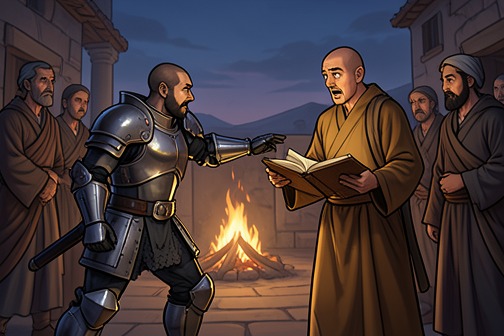
[The Monk](entity:character-recall-character-the-monk-6d5091022914) begins a long series of tragedies about people who fall from power, including [Lucifer](entity:character-recall-character-lucifer-904fe352bf46), [Adam](entity:character-recall-character-adam-7e6d3c5ddcc8), [Samson](entity:character-recall-character-samson-c87592e1fded), [Hercules](entity:character-recall-character-hercules-aa3bc2249363), [Nebuchadnezzar](entity:character-recall-character-nebuchadnezzar-d2eba2e9f5e2), [Belshazzar](entity:character-recall-character-belshazzar-adb0a3ebe22e), [Zenobia](entity:character-recall-character-zenobia-cfa35d36adbf), [Nero](entity:character-recall-character-nero-399546edf8a1), [Holofernes](entity:character-recall-character-holofernes-646435a117e3), [Alexander the Great](entity:character-recall-character-alexander-the-great-154e18d9ad80), [Julius Caesar](entity:character-recall-character-julius-caesar-407982b36437), and [Croesus](entity:character-recall-character-croesus-fb453d61815f). [The Knight](entity:character-recall-character-the-knight-7d7d568c8fd2) interrupts him, finding the repeated reversals too depressing.
The interruption changes the emotional direction of the storytelling contest. The pilgrims reject exhaustive tragedy in favor of a tale that can provide movement, comedy, and relief.
immediately after the Monk’s interruption
The Nun’s Priest Takes Over
[Harry Bailly](entity:character-recall-character-harry-bailly-c19f8e2f6655) asks [Sir John](entity:character-recall-character-sir-john-543b041f6123) to tell a cheerful tale, teasing him about his poor horse. Sir John agrees and begins the story of a widow, her household, and her magnificent rooster.
The change of teller replaces aristocratic tragedy with animal fable. Yet the tale retains the collection’s major concerns: dreams, persuasion, vanity, danger, and the instability of apparent wisdom.
early one morning in spring
Chanticleer Dreams of a Fox
[Chanticleer](entity:character-recall-character-chanticleer-8c58375627f3), the widow’s proud rooster, groans in his sleep and tells [Pertelote](entity:character-recall-character-pertelote-746b44aed3ae) that he dreamed of a beast resembling a fox attacking him. Pertelote dismisses the dream as the product of humors, overeating, or illness and advises a purge.
Their debate stages the conflict between skepticism and prophetic interpretation. Chanticleer cites examples in which dreams foretell murder, shipwreck, and death, but he ultimately follows Pertelote’s confidence.
later the same spring morning
Chanticleer Defies the Dream
After debating dreams, [Chanticleer](entity:character-recall-character-chanticleer-8c58375627f3) descends from his perch and struts through the yard with his hens. His fear disappears, and he rejoices in the sun, the season, and his authority over the flock.
His confidence makes him vulnerable. The narrative’s reflections on divine foreknowledge and free will suggest that his choice is both personal and part of a larger order he cannot understand.
the same morning
Russell Enters the Yard
[Russell](entity:character-recall-character-russell-1c8a85e72bbe), a fox who has lived near the grove for three years, hides in the cabbage bed and waits for [Chanticleer](entity:character-recall-character-chanticleer-8c58375627f3). He is described as a murderer and false flatterer before he even speaks.
His concealed presence fulfills the dream’s warning and introduces the tale’s central danger: verbal manipulation disguised as friendship.
moments after Russell is discovered
Russell Flatters Chanticleer
[Chanticleer](entity:character-recall-character-chanticleer-8c58375627f3) sees [Russell](entity:character-recall-character-russell-1c8a85e72bbe) and prepares to flee, but the fox claims to admire his singing. Russell praises Chanticleer’s voice, compares him favorably with great singers, and invokes his parents to win his trust.
Flattery defeats vigilance more effectively than force. Chanticleer’s vanity makes him perform precisely the act that gives Russell access to his throat.
immediately after the flattery
Russell Captures Chanticleer
[Chanticleer](entity:character-recall-character-chanticleer-8c58375627f3) closes his eyes, stretches his neck, and crows. [Russell](entity:character-recall-character-russell-1c8a85e72bbe) seizes him by the throat and carries him toward the woods while the hens and household discover what has happened.
The capture vindicates the dream and exposes the cost of self-confidence. Chanticleer’s voice, his proudest possession, becomes the mechanism of his apparent ruin.
immediately after Chanticleer’s capture
The Household Chases Russell
The widow, her daughters, dogs, villagers, animals, and swarms of bees pursue [Russell](entity:character-recall-character-russell-1c8a85e72bbe) with staffs, shouting, trumpets, horns, and desperate cries. The chase becomes a chaotic public spectacle.
The collective uproar reverses the fox’s advantage. His private deception is exposed to the entire community, and the social world he tried to evade closes around him.
during the pursuit
Chanticleer Escapes
[Chanticleer](entity:character-recall-character-chanticleer-8c58375627f3) tells [Russell](entity:character-recall-character-russell-1c8a85e72bbe) that, if he were the fox, he would turn and mock the pursuers by declaring that he intends to eat the rooster in front of them. Russell opens his mouth to perform the boast, and Chanticleer flies into a tree.
The same vanity that trapped Chanticleer now traps Russell. The fable closes by warning against flatterers, careless speech, and the refusal to learn from danger.
later on the pilgrimage
The Canon’s Yeoman Arrives
A sweating Canon and his Yeoman overtake the company near Boughton under Blean. [The Yeoman](entity:character-recall-character-the-yeoman-a31337b8d436) praises his master’s supposed knowledge and claims that the Canon can transform the road into gold and silver.
The extravagant claims invite scrutiny. [The Canon](entity:character-recall-character-the-canon-0ed21554178c)’s poor clothing and anxious secrecy contradict the Yeoman’s praise, exposing the difference between alchemical reputation and material reality.
during the company’s questioning
The Canon Flees
[The Yeoman](entity:character-recall-character-the-yeoman-a31337b8d436) admits that he and the Canon live by deception and fail repeatedly in their attempts to multiply metals. When the Canon hears the revelations, he threatens the Yeoman and then rides away in shame.
His flight frees the Yeoman to tell the truth. The tale becomes an exposure of alchemical fraud rather than a celebration of occult mastery.
after the Canon’s departure
The Yeoman Condemns Alchemy
[The Canon](entity:character-recall-character-the-canon-0ed21554178c)’s Yeoman describes seven years of poverty, debt, ruined health, smoke-blackened skin, and wasted labor. He catalogs furnaces, chemicals, vessels, astrological calculations, and failed attempts to discover the philosopher’s stone.
[Alchemy](entity:concept-recall-concept-alchemy-402882709290) is portrayed as a self-perpetuating fantasy. Its practitioners mistake technical vocabulary and repeated failure for progress, sacrificing their possessions to hope.
in the Yeoman’s exemplum
The Canon Cheats the Priest
A second Canon borrows money from [The Canon](entity:character-recall-character-the-canon-0ed21554178c)’s Priest and repays it promptly, gaining his trust. He then promises to teach him how to turn quicksilver into silver, using prepared coals, concealed filings, powders, molds, and sleight of hand.
The fraud succeeds because the Priest wants to believe. The Canon’s apparent generosity is only bait for a larger extraction of money.
after the staged transformations
The Priest Buys the Formula
[The Canon](entity:character-recall-character-the-canon-0ed21554178c) produces several convincing silver bars and persuades The Canon’s Priest to pay forty pounds for the secret formula. Once the Canon departs, the Priest discovers that the formula does not work and that he has been deceived.
The episode turns alchemy into a moral and economic trap. The glittering bars are real, but the promised method is worthless, demonstrating that appearances can be manufactured to exploit greed.
ending of the book
Alchemy Is Renounced
[The Canon](entity:character-recall-character-the-canon-0ed21554178c)’s Yeoman concludes that philosophers deliberately conceal the stone’s nature and that God does not permit the secret to be disclosed except by divine inspiration. He advises everyone to abandon the search before it destroys their wealth and judgment.
The final tale ends the collection with a warning against deceptive knowledge and acquisitive hope. Its moral joins the earlier tales: worldly promises, when pursued without wisdom or charity, become instruments of ruin.